

Choosing a healing path—whether for depression, anxiety, or trauma—is deeply personal. For many, the crossroads between pharmaceutical medications and natural therapies like psilocybin can feel confusing or even overwhelming.
Should I stick to what the doctor prescribed?
Should I explore the path of natural medicine?
Can I combine both?
What will truly help me heal—not just function?
At SoulCybinMI, we honor every step of your journey, whether you follow conventional medicine, explore sacred plant medicines like psilocybin, or find your way through a blend of both. Our intention isn’t to sway you in one direction, but rather to provide clear, honest information—so you can make empowered decisions about your healing. Psilocybin vs Antidepressants
Antidepressants, especially SSRIs (Selective Serotonin Reuptake Inhibitors), are among the most commonly prescribed medications for mental health issues. These synthetic pharmaceuticals are designed to regulate neurotransmitters—primarily serotonin—by increasing its availability in the brain. This aims to balance mood, relieve anxiety, and curb depressive symptoms.
Antidepressants are typically taken once daily. The goal is consistency: stabilize the brain’s chemistry and create a predictable emotional baseline.
For many, this regimen offers genuine relief—especially in acute or crisis phases. However, others report challenges, including:
It’s also worth noting that antidepressants may address the symptoms of mental distress but not necessarily the root causes—such as trauma, spiritual stagnation, or disconnection from purpose. Psilocybin vs Antidepressants
Psilocybin is the psychoactive compound in “magic mushrooms,” revered for centuries in spiritual and healing ceremonies. At high doses, it induces profound visionary experiences. But in a microdose—roughly 1/10 to 1/20 of a full dose—it creates no hallucinations, and yet subtly shifts awareness, energy, and mood.
Unlike pharmaceuticals, psilocybin is not a synthetic compound. It’s a whole-organism medicine with its own “intelligence,” interacting dynamically with the mind and body. Microdosing psilocybin is less about symptom suppression and more about awakening—a soft nudge toward presence, creativity, clarity, and self-awareness. Psilocybin vs Antidepressants
Here’s what makes psilocybin microdosing unique:
This relationship-based medicine invites curiosity and trust, not blind compliance. Psilocybin vs Antidepressants
Microdosing psilocybin has gained attention from both scientists and seekers for its potential to uplift and rewire the brain without causing overwhelming effects. Here are some of its most reported benefits:
These benefits are often reported by those who approach psilocybin with respect, intention, and proper guidance.
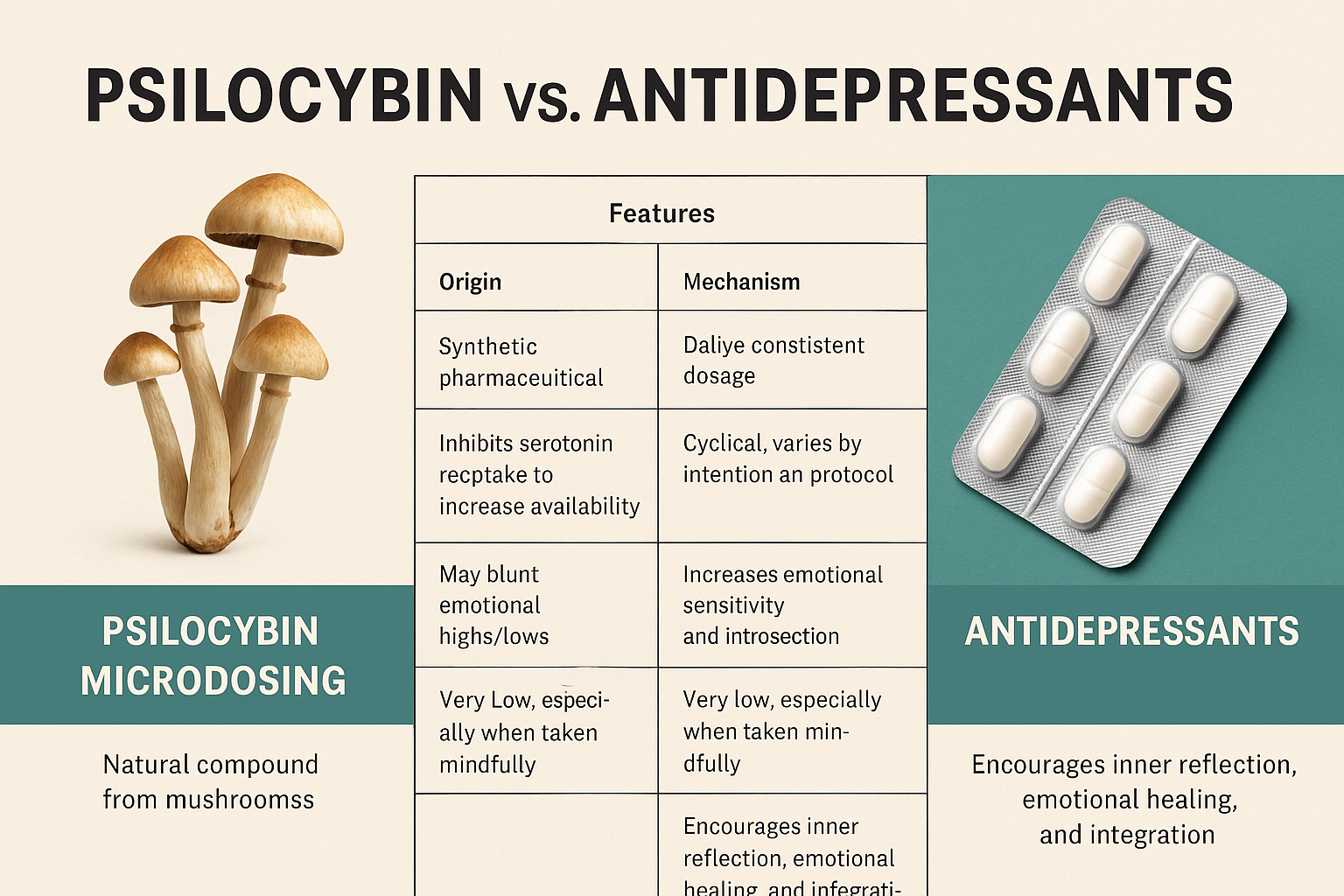
| Feature | Antidepressants (SSRIs) | Psilocybin Microdosing |
| Origin | Synthetic pharmaceutical | Natural compound from mushrooms |
| Mechanism | Inhibits serotonin reuptake to increase availability | Modulates serotonin receptors and enhances neuroplasticity |
| Dosage Pattern | Daily, consistent dosage | Cyclical, varies by intention and protocol |
| Impact on Emotion | May blunt emotional highs/lows | May increase emotional sensitivity and introspection |
| Dependency Risk | Moderate to high (withdrawal symptoms reported) | Very low, especially when taken mindfully |
| Holistic Integration | Often ignores spiritual/emotional root causes | Encourages inner reflection, emotional healing, and integration |
If you’re currently taking an antidepressant, it’s critical to understand that combining SSRIs with psilocybin can pose risks. Psilocybin vs Antidepressants
Both compounds affect serotonin. When taken together, they may contribute to serotonin syndrome, a serious and potentially fatal condition involving:
Never abruptly stop taking antidepressants in order to start microdosing. Always consult a trusted, licensed medical professional or psychotherapist experienced in integrative mental health before making changes.
SoulCybinMI does not endorse stopping medication without proper supervision. Psilocybin vs Antidepressants
Psilocybin is not just a spiritual medicine—it’s gaining recognition in mainstream science. Research from institutions like Johns Hopkins and Imperial College London confirms its potential in treating:
Dr. Robin Carhart-Harris, Dr. Rosalind Watts, and podcast host Andrew Huberman have all highlighted how psilocybin supports brain plasticity, resets emotional circuits, and enables meaning-making in the healing process.
In fact, some researchers suggest a single therapeutic dose of psilocybin may offer longer-lasting results than months on antidepressants.
At SoulCybinMI, we are not in the business of “quick fixes.” We hold space for healing that is thoughtful, gentle, intentional—and often non-linear. Psilocybin vs Antidepressants
We believe:
We offer access to ceremonially aligned, lab-tested psilocybin microdosing protocols to those who feel called to explore a natural path—always with education, privacy, and support. Psilocybin vs Antidepressants
This is a common question, and the answer depends entirely on your specific medication, health history, and intentions.
Some people eventually taper off antidepressants and transition to psilocybin with professional guidance. Others maintain a pharmaceutical regimen for stability while exploring microdosing only after safe discontinuation. Psilocybin vs Antidepressants
Important: There is no one-size-fits-all. Your path must be honored, not rushed. Please consult with a psychotherapist, integrative psychiatrist, or trained psychedelic practitioner before exploring this option.
The question isn’t “which is better?”—it’s “which is right for you, right now?”
Antidepressants can be lifelines for acute crises. Psilocybin microdosing can be allies in transformation. They don’t have to be enemies—but they do require discernment.
At SoulCybinMI, we walk with you—not as gurus, but as grounded guides, helping you remember your own wisdom.
You are your own best medicine.
We’re just here to remind you. Psilocybin vs Antidepressants
Not automatically. Some users report better results with psilocybin, but switching should only be done under medical supervision to avoid withdrawal or serotonin syndrome. Psilocybin vs Antidepressants
Psilocybin is still federally illegal in most countries, including the U.S., but decriminalized in certain cities. SoulCybinMI serves in alignment with local laws and spiritual frameworks. Psilocybin vs Antidepressants
Some feel subtle shifts within a few days; others notice improvements over 1–2 weeks. Psilocybin works gently and accumulates through reflection and intention.
It’s not recommended. Common protocols suggest 1 day on, 2 days off (Fadiman Protocol) to avoid tolerance buildup and support integration. Psilocybin vs Antidepressants
When done responsibly, side effects are rare. Some users report mild nausea or fatigue at first, which usually subsides. Always start with a low dose and journal your experience. Psilocybin vs Antidepressants
Stopping antidepressants suddenly can cause severe withdrawal. Transitioning to microdosing should be gradual and monitored by a healthcare professional.
Psilocybin promotes the growth of new neural connections, helping rewire thought patterns, emotional responses, and behaviors—especially helpful in trauma recovery. Psilocybin vs Antidepressants
Yes, if dosed properly. Microdosing should not impair motor skills or cognition. However, always self-assess and avoid operating machinery if you feel off-balance.
Not in microdose amounts. You’ll feel grounded, maybe slightly uplifted, but not euphoric or hallucinating. The experience is subtle and functional.
Visit SoulCybinMI.org to explore science-backed education, protocols, product guidance, and stories from the community.